5 Things Your Fitness Tracker Cannot Measure and What to Use Instead
Quick Answer: Trackers measure movement, heart rate, and duration reasonably well. They estimate calories, sleep stages, and recovery, and they cannot measure strength, muscle mass, hydration, actual sleep depth, or readiness at all - those numbers are models built on the few signals the device does have. The replacements are simple and free: a rep log for strength, a morning urine check for hydration, a fixed-route walk for aerobic progress, and how you feel at the third set for readiness.
This is not an argument against wearing one. It is an argument for knowing which numbers on your wrist are measurements and which are educated guesses, because you will make better decisions with the first category and worse ones with the second.

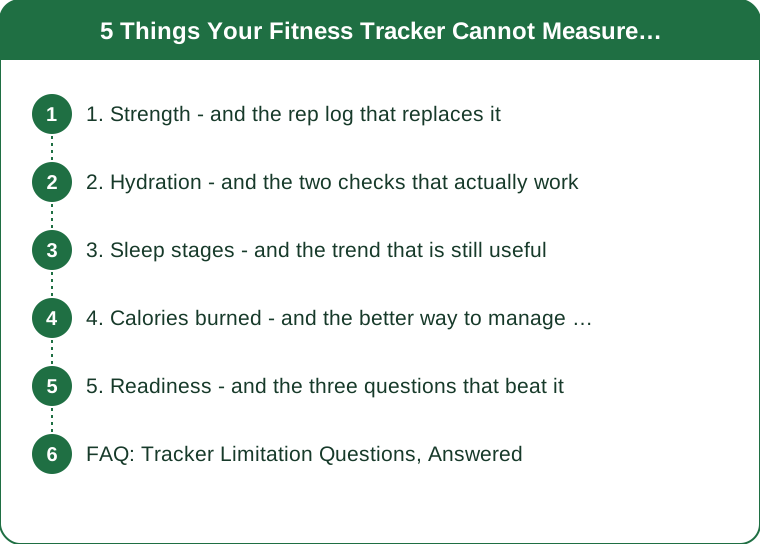
1. Strength - and the rep log that replaces it
Why it cannot: a wrist device has no way of knowing what is in your hands. It sees heart rate and wrist acceleration, neither of which distinguishes a 5kg dumbbell from a 25kg one. Some trackers now attempt rep counting from motion, and accuracy varies enormously by exercise - it does better on a strict bicep curl than on almost anything else.
This is why heart rate during lifting is such a poor guide to effort. A heavy set of five raises heart rate less than a light set of twenty, while producing far more of the adaptation you are training for.
What to use instead: a rep log. Weight, sets, reps, and a note on how the last set felt. Three lines per exercise in a notes app.
It takes ten seconds and it gives you the one thing a tracker cannot: a direct, unambiguous record of whether you are getting stronger. If the numbers on the page go up over eight weeks, the training is working. No estimate involved.
Add one monthly benchmark - a set to two reps from failure on one main lift - and you have better strength data than any consumer device produces.
2. Hydration - and the two checks that actually work
Why it cannot: hydration status depends on plasma volume and electrolyte concentration, and there is no consumer wrist sensor that measures either. Some devices infer it from skin temperature or sweat estimates, which are models several steps removed from the thing itself.
The hydration figures in most apps are simply your logged intake against a formula based on your weight and activity - useful as a reminder, not a measurement of anything about your body.
What to use instead: two things, both free.
Morning urine colour. Pale straw is the target. Consistently dark first thing is the most reliable practical indicator of under-hydration available outside a lab.
Weight change across a session. Weigh before and after a hard workout. A drop of more than about 2% of body weight indicates you needed more fluid during it. For a 65kg person that is 1.3kg, which is a lot of fluid and easier to lose than people expect in a hot room.
Both of these are more informative than any hydration screen on any device, and they cost nothing.
3. Sleep stages - and the trend that is still useful
Why it cannot: sleep stages are defined by brain activity, measured with EEG. A wrist device sees movement and heart rate variability and infers stages from them. The inference is genuinely clever and it is still an inference.
Validation studies consistently find that consumer trackers do reasonably well at total sleep time and much less well at staging - particularly at distinguishing deep sleep from light sleep, which is exactly the number people care about most.
What to use instead: use the tracker, but use different numbers from it.
Total sleep duration and bedtime consistency are the two it measures best and the two that matter most. Track those and ignore the stage breakdown.
Then add a subjective rating. A 1-5 score for how rested you feel, noted in the morning. Over a month, your own rating correlates better with your actual functioning than any stage percentage, and it is the number that should drive decisions.
The trap to avoid: reading a poor deep sleep percentage and feeling worse than you did before you looked. This effect is documented well enough to have a name - orthosomnia - and it is a real cost of a number that was estimated in the first place.

4. Calories burned - and the better way to manage intake
Why it cannot: calorie expenditure depends on your actual body composition, mechanical efficiency, and the specific activity. A tracker has your age, weight, height, heart rate, and movement. It builds an estimate from those, and the error margins in validation studies are large - frequently 20-30% off, and worse for strength training and interval work than for steady cardio.
The direction of the error matters: most devices overestimate, which is why the extra portion earned on a tracker screen so often fails to show up as expected on the scale.
What to use instead: stop treating exercise calories as spendable, and manage the input side.
Set intake based on your weight trend rather than your burn estimate. Weigh yourself under the same conditions three or four mornings a week and use the weekly average. If the average is going the wrong way over three weeks, adjust intake. That closed loop uses real data about your actual body instead of an estimate about your activity.
Use the tracker for consistency, not accounting. Its calorie number is fairly consistent with itself, so it works as a relative measure - this week versus last week - even though the absolute figure is unreliable.
5. Readiness - and the three questions that beat it
Why it cannot: readiness and recovery scores combine heart rate variability, resting heart rate, sleep estimates, and recent activity into a single number. Every input is a real signal; the weighting is a proprietary guess, and it has no access to the things that most determine whether today’s session goes well - your stress, your last meal, whether you are getting ill, or what your legs actually feel like.
HRV in particular is highly individual and sensitive to measurement conditions. A number that dropped because you slept on your other arm looks identical to one that dropped because you are overreaching.
What to use instead: three questions, answered honestly, before you train.
How do the specific muscles from your last session feel? Sore is fine. Sharp, one-sided, or joint-centred is not.
Did you sleep less than six hours? If yes, plan to cut volume rather than load.
How does the third set feel? This is the real test and it happens during the session, not before it. If set three at your normal weight moves like set one usually does, proceed. If it does not, stop at four sets instead of six.
That last one is more informative than any readiness score, because it measures today rather than predicting it.
FAQ: Tracker Limitation Questions, Answered
So is a tracker worth wearing at all?
Yes. Steps, heart rate during steady cardio, workout duration, and sleep timing consistency are genuinely well measured, and the behavioural nudge from wearing one is real. The value is in the measurements, not the scores.
Which numbers should I actually look at weekly?
Total weekly active minutes, resting heart rate trend, average sleep duration, and step count. Four numbers, all measured rather than modelled, all meaningful over weeks.
Does a chest strap fix the accuracy problem?
For heart rate, yes - a chest strap is substantially more accurate than a wrist sensor, especially during lifting and intervals. It does nothing for calories, sleep staging, or readiness, because those are model problems rather than sensor problems.
What about a smart ring?
Same limitations, different sensor placement. Rings tend to do better on resting measurements and worse during exercise. The categories on this list stay uncertain regardless of the device.
TL;DR:
- Strength: a tracker cannot see the weight. Keep a rep log.
- Hydration: no sensor measures it. Morning urine colour and pre/post workout weight.
- Sleep stages: estimated, not measured. Use duration and consistency, plus your own 1-5 rating.
- Calories: frequently 20-30% off and usually high. Manage intake by weekly weight trend.
- Readiness: a model, not a measurement. How set three feels beats it every time.
The useful mental split is measurements versus models. Trust the measurements, treat the models as conversation starters, and keep the four free checks - they are more accurate than anything on your wrist.
Keep Reading
This article is for general informational and styling purposes only. Fit, sizing, and product availability may vary.