5 Tracker Screens Worth Checking After a Week Off
Quick Answer: After a week off, five screens tell you almost everything: resting heart rate trend, HRV trend, sleep timing consistency, weekly step total, and cardio fitness estimate. Read all five as trends across seven or more days rather than as single-day numbers, and expect resting heart rate and HRV to be temporarily worse for reasons that have nothing to do with fitness - travel, alcohol, disrupted sleep, and heat all move them. Cardio fitness estimates barely change in a week, so if yours dropped sharply, that is a measurement artefact.
The holiday was excellent. The app is being rude about it.
Here are the five screens worth actually looking at, and how to read each without drawing the wrong conclusion.

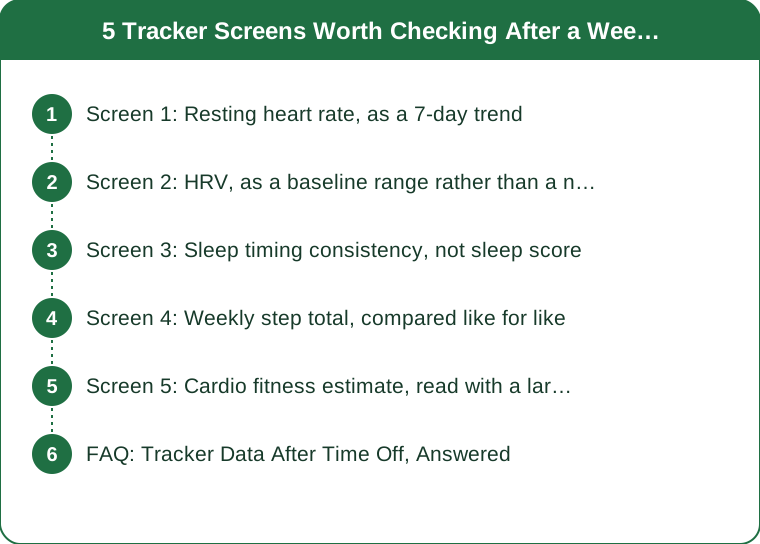
Screen 1: Resting heart rate, as a 7-day trend
What to look at: the trend line over the last two to three weeks, not today’s number.
What it means after a break: resting heart rate commonly rises during and just after time off, and the causes are usually alcohol, disrupted sleep, heat, and travel rather than lost fitness. A rise of a few beats that returns to baseline within a week is entirely normal.
What would be worth noting: a rise of more than about 5 to 7 beats sustained beyond a week, particularly with fatigue - which is more often an illness signal than a training signal.
What not to do: compare a single morning reading against your best-ever morning reading. The day-to-day variation on this metric is large enough to make single comparisons meaningless.
Practical read: if the seven-day average is back within two beats of your pre-break baseline after five or six days, nothing happened.
Screen 2: HRV, as a baseline range rather than a number
What to look at: whether today sits inside your personal normal range, which most apps display as a band.
What it means after a break: HRV is highly sensitive to alcohol, poor sleep, dehydration, and heat, all of which are common on a week away. A depressed HRV in the days after a holiday is usually reporting last week’s evenings, not your fitness.
Why the absolute number is useless: HRV varies enormously between individuals. Comparing yours to anyone else’s tells you nothing at all - only your own baseline matters.
What to actually do with it: use it to decide the intensity of the first session back, not to decide whether the break was a mistake. Low HRV plus feeling flat is a reasonable argument for an easy first session.
Give it a week before judging. HRV baselines take several days of normal routine to re-establish, and the first two days back are the least informative of the month.
Screen 3: Sleep timing consistency, not sleep score
What to look at: the bedtime and wake time consistency chart, if your app has one. This is the screen almost nobody opens and it is the most useful one on this list.
What it means after a break: a week of late nights and late mornings shifts your circadian timing, and the resulting fatigue is a timing problem rather than a quantity problem. The consistency chart shows this clearly where a sleep score does not.
Why sleep scores mislead: consumer sleep staging is approximate, and a single composite score hides the variable that actually matters, which is regularity.
What to do: fix wake time first and hold it for a week, including the weekend. Bedtime follows.
Expect three to seven days. A shift of an hour or more typically needs several days of consistent wake time and morning light to settle.

Screen 4: Weekly step total, compared like for like
What to look at: total steps for the last full week versus a typical week before the break.
Why this one is more useful than it looks: it is the least noisy metric on any tracker and it captures overall daily movement, which is the thing most affected by a change in routine.
What it often shows: many people move considerably more on holiday than at home, so a post-holiday drop is a return-to-desk effect rather than a break effect.
What to do with it: if the first week back is dramatically lower than both the holiday and your normal baseline, the problem is your return-to-work routine, not the holiday.
One caveat: step counts are not comparable between devices or wear positions, so only compare your own data with itself.
Screen 5: Cardio fitness estimate, read with a large pinch of salt
What to look at: the long-term trend over months, ignoring anything shorter.
What it means after a week: essentially nothing. Meaningful changes in cardiorespiratory fitness take longer than a week in either direction, so a sharp drop reflects the algorithm’s inputs rather than your physiology.
Why it moves anyway: these estimates are derived from heart rate during activity, so a hot week, poor sleep, or a run in unfamiliar terrain all shift the output without any change in fitness.
Detraining reality: measurable losses in cardiorespiratory fitness generally take a couple of weeks or more of complete inactivity to appear, and a week off with normal holiday walking is not that.
What to do: look at this screen monthly, not weekly. Checked weekly it produces anxiety and no information.
And the honest summary: four of these five screens will look worse after a week off and be back to normal within a week of normal routine. Read trends, give it seven days, and make the first session back an easy one.
FAQ: Tracker Data After Time Off, Answered
Why is my resting heart rate higher after a holiday?
Alcohol, disrupted sleep, heat, and travel all raise resting heart rate, and they are all common on a week away. A rise of a few beats that returns to baseline within about a week is normal and is not lost fitness.
Does a week off actually reduce fitness?
Meaningful reductions in cardiorespiratory fitness generally take more than a week of complete inactivity, and most holidays involve more walking than a normal week, not less.
Why did my HRV drop so much?
HRV is very sensitive to alcohol, poor sleep, dehydration, and heat. After a break it is usually reporting last week’s evenings rather than your training state. Give it a week of normal routine before drawing conclusions.
Which tracker metric is the most reliable?
Weekly step total, because it is the least algorithmically derived. Resting heart rate is next, read as a seven-day trend rather than a daily number.
Should I trust my sleep score?
Use the sleep timing consistency chart instead. Consumer sleep staging is approximate, and regularity of bedtime and wake time is the variable that actually predicts how you feel.
TL;DR:
- Read every metric as a trend over seven or more days; single-day numbers after a break are noise.
- Resting heart rate and HRV are reporting alcohol, heat, travel, and disrupted sleep - not lost fitness.
- Open the sleep timing consistency chart rather than the sleep score; regularity is the variable that matters.
- Weekly step total is the least noisy metric on any tracker and the most useful comparison.
- Cardio fitness estimates barely move in a week - check that one monthly, and make the first session back an easy one.
Keep Reading
This article is for general informational and styling purposes only. Fit, sizing, and product availability may vary.