5 Fitness Tracker Metrics Actually Worth Checking Every Week (and 3 to Mostly Ignore)
Quick Answer: Resting heart rate trend, sleep consistency, weekly step average, heart rate variability trend, and active minutes are the five metrics most worth a weekly glance — they reflect real, actionable trends. Daily calorie burn precision, single-night sleep scores, and stress scores are the three most commonly over-interpreted and least reliable on their own.
A fitness tracker hands you a dashboard full of numbers, and checking all of them daily is a fast route to noise, not insight. A short, deliberately narrow list of metrics — checked weekly as a trend, not daily as a verdict — is what actually helps.

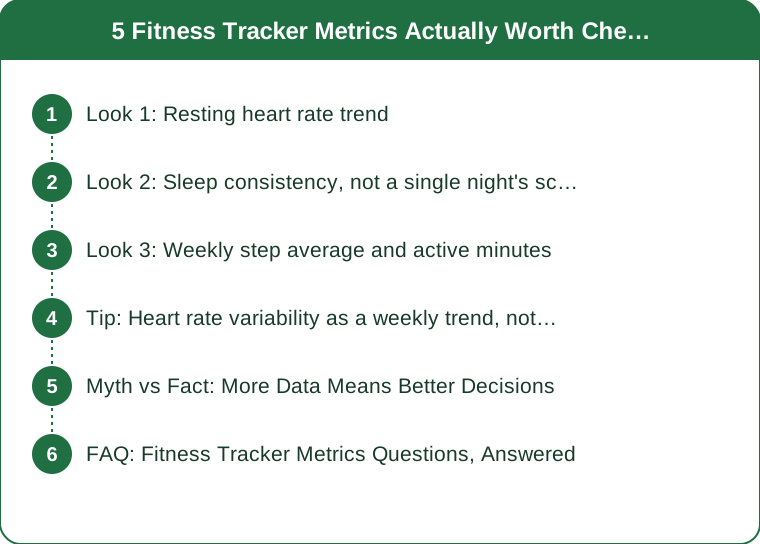
Look 1: Resting heart rate trend
A gradual downward trend in resting heart rate over weeks generally reflects improving cardiovascular fitness, while a sudden upward shift can flag overtraining, illness, or poor recovery before you consciously feel it. This is one of the more reliable long-term trend metrics most trackers offer.
Look 2: Sleep consistency, not a single night’s score
A consistent sleep and wake window across the week matters more for how you feel than any single night’s sleep score, which can swing based on tracker algorithm quirks alone. Look at the weekly pattern, not the daily number.
Look 3: Weekly step average and active minutes
A weekly average smooths out normal day-to-day variation and gives a much more honest picture of actual activity level than obsessing over hitting an identical step count every single day, which isn’t realistic or necessary.

Tip: Heart rate variability as a weekly trend, not a daily number
HRV fluctuates meaningfully day to day for reasons unrelated to fitness (hydration, alcohol, stress), so a single day’s reading is close to meaningless — the multi-week trend direction is the actually useful signal here.
Myth vs Fact: More Data Means Better Decisions
Myth: Checking every available metric daily gives you the most complete picture of your health. Fact: Most single-day readings are noisy enough that daily checking creates anxiety without adding useful information — weekly trends across a handful of metrics are more reliable.
Myth: Calorie burn numbers from a tracker are precise enough to plan nutrition around exactly. Fact: Wrist-based calorie estimates carry meaningful error margins and are better used as a rough relative comparison than an exact number to build a nutrition plan around.
FAQ: Fitness Tracker Metrics Questions, Answered
Why shouldn’t I trust the daily stress score?
Most stress scores are derived indirectly from heart rate variability and movement patterns, which can be affected by many non-stress factors, making single-day stress scores unreliable compared to longer-term trends.
Is it worth checking metrics daily during a specific training block?
During intense blocks, checking resting heart rate and HRV trend slightly more often can help catch early overtraining signs, but this is still about the trend direction, not any single day’s number.
Should I ignore calorie burn numbers completely?
Not completely — they’re useful for relative comparison (was this workout harder than that one) but shouldn’t be treated as precise enough to build a strict nutrition plan around.
TL;DR:
- Resting heart rate trend and HRV trend matter more as multi-week patterns than single-day numbers
- Sleep consistency across the week beats obsessing over one night’s sleep score
- Weekly step and active-minute averages give a more honest activity picture than daily targets
- Treat calorie burn and stress scores as rough relative signals, not precise daily verdicts
Keep Reading
This article is for general informational and styling purposes only. Fit, sizing, and product availability may vary.