Why Your Fitness Tracker's Heart Rate Reading Goes Haywire During Weight Lifting
Quick Answer: Wrist-based trackers lose heart rate accuracy during lifting mainly because grip pressure and wrist flexion during reps disrupt the optical sensor’s contact with skin — not because your heart rate is actually erratic. A chest strap stays far more accurate through resistance training.
Mid-set, your tracker jumps from 90 to 160 to 40 bpm and back, none of which matches how you actually feel. That’s a sensor problem, not a heart problem.

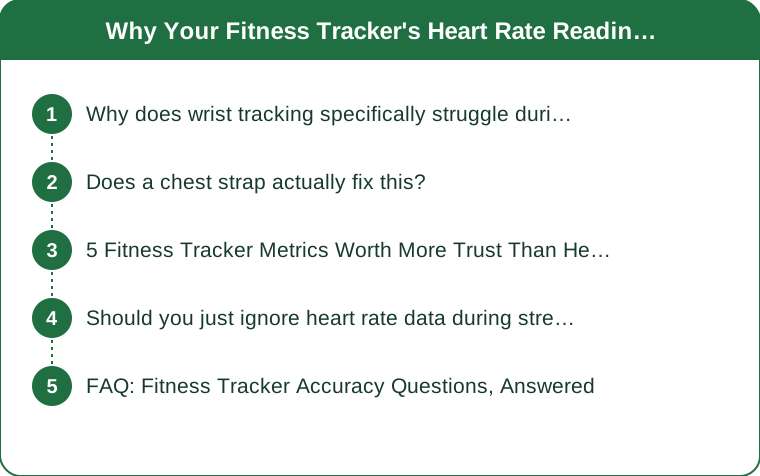
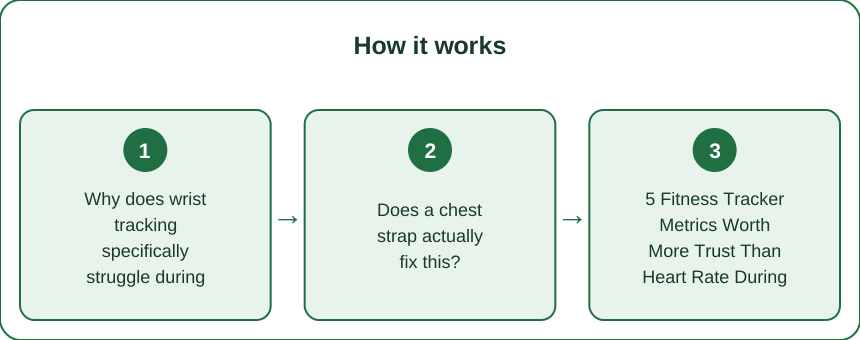
Why does wrist tracking specifically struggle during lifting?
Optical heart rate sensors read blood flow through light reflection against the skin — a technology that depends on stable, consistent skin contact. Gripping a barbell or dumbbell tenses forearm muscles and shifts the watch slightly with every rep, breaking that contact repeatedly.
Running and cycling, by contrast, keep the wrist relatively still relative to the sensor, which is why the same tracker reads accurately in cardio but erratically under load.
Does a chest strap actually fix this?
Yes, significantly — chest strap monitors read electrical signals directly from the heart rather than optical blood flow, and they’re not affected by grip or wrist movement at all. For anyone who takes their lifting heart rate data seriously, a strap is the more reliable tool.
If a strap isn’t practical, an armband tracker (worn on the bicep) is a middle option that suffers less wrist-flexion interference than a watch.

5 Fitness Tracker Metrics Worth More Trust Than Heart Rate During Lifting
1. Rep and set counting (on trackers that support it) tends to be reasonably reliable since it’s based on motion patterns, not optical sensing.
2. Total workout duration — simple timing is accurate regardless of sensor issues.
3. Post-workout heart rate recovery, checked once you’ve stopped moving and the sensor has stable contact again.
4. Daily resting heart rate, measured overnight when the wrist is still.
5. Sleep tracking, which benefits from the same stillness that makes lifting tracking unreliable.
Should you just ignore heart rate data during strength workouts?
For real-time in-set numbers, largely yes — treat spikes and drops during active lifting as noise rather than signal. Trust the reading in the rest periods between sets, when your wrist is relatively still and the sensor stabilizes.
If heart rate zone training matters to you specifically for strength work, that’s the strongest case for switching to a chest strap rather than trying to interpret unreliable wrist data.
FAQ: Fitness Tracker Accuracy Questions, Answered
Is it worth buying a chest strap just for lifting?
If you’re already tracking heart rate zones seriously, yes — it removes the single biggest accuracy issue in strength training data.
Does a tighter watch band fix the accuracy problem?
It helps somewhat by reducing movement, but it doesn’t eliminate the grip-related muscle tensing that’s the core issue — it’s a partial fix, not a full one.
Are calorie burn estimates during lifting also affected?
Yes — since calorie estimates on most trackers are partly derived from heart rate, the same inaccuracy carries through to burn numbers during resistance training.
TL;DR:
- Wrist trackers lose accuracy during lifting because grip and wrist flexion disrupt optical sensor contact
- Chest straps read electrical signals and aren’t affected by grip at all
- Trust rest-period readings between sets more than in-set spikes
- Calorie burn estimates during lifting inherit the same heart rate inaccuracy
The erratic number isn’t your heart acting up — it’s the sensor losing its grip, literally.
Keep Reading
This article is for general informational and styling purposes only. Fit, sizing, and product availability may vary.