Tour: Why Your Fitness Tracker Gives Different Numbers for the Exact Same Workout
Quick Answer: Fitness trackers use algorithms based on heart rate, movement patterns, and personal stats to estimate calories and effort — factors like hydration, sleep quality, ambient temperature, and even how snugly the device fits that day all shift these readings, so variation between identical workouts is expected, not a sign of a broken device.

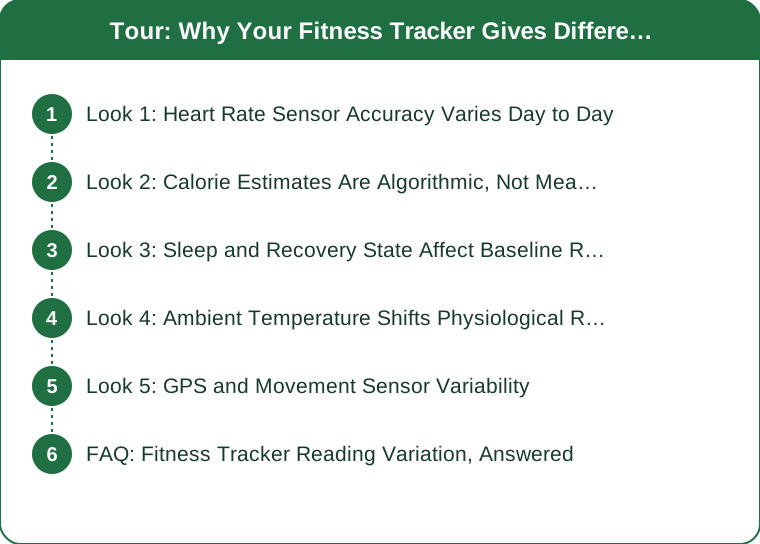
Look 1: Heart Rate Sensor Accuracy Varies Day to Day
Optical heart rate sensors read blood flow through skin, which is affected by hydration level, skin temperature, and how snugly the device sits on your wrist that day. A slightly looser or tighter fit than usual can shift heart rate readings enough to change downstream calorie estimates.
Look 2: Calorie Estimates Are Algorithmic, Not Measured
Calorie burn numbers are estimated using formulas based on heart rate, weight, age, and movement, not directly measured — small input variations (like a slightly different resting heart rate that day) propagate into different calorie estimates even for physically identical workouts.
Look 3: Sleep and Recovery State Affect Baseline Readings
Poor sleep the night before can elevate resting and working heart rate the next day, which most tracker algorithms factor into effort and calorie calculations — meaning identical physical output can register as ‘harder’ on a poorly-recovered day.

Look 4: Ambient Temperature Shifts Physiological Response
A warmer environment increases heart rate for the same physical effort as your body works to manage heat, which trackers interpret as increased intensity even though the actual exercise performed was identical to a cooler-day session.
Look 5: GPS and Movement Sensor Variability
For outdoor workouts, GPS signal quality varies with weather, tree cover, and building density, affecting distance and pace calculations independent of your actual performance — this is a separate source of day-to-day variation from the heart-rate-based metrics.
FAQ: Fitness Tracker Reading Variation, Answered
Should you trust the day-to-day trend or the single-workout number more?
The trend over time is generally more reliable than any single reading, since it averages out much of this daily variation.
Does a chest strap heart rate monitor reduce this variability?
Yes, chest straps use electrical signals rather than optical sensors and tend to be more consistently accurate, especially during high-intensity movement.
Is it worth recalibrating tracker settings periodically?
Yes — updating weight, age, and resting heart rate settings periodically helps keep the underlying calculations more accurate over time.
TL;DR:
- Heart rate sensor readings vary with hydration, fit, and skin conditions daily
- Calorie numbers are algorithmic estimates, not direct measurements
- Sleep quality and ambient temperature both shift physiological readings
- GPS variability adds separate variation for outdoor workout metrics
- Trust the overall trend more than any single day’s exact number
Different numbers for the same workout reflect real physiological and environmental variables, not a broken tracker — the trend over weeks tells you more than any single session ever will.
Keep Reading
This article is for general informational and styling purposes only. Fit, sizing, and product availability may vary.