5 Fitness Tracker Metrics Actually Worth Checking (And 3 to Mostly Ignore)
Quick Answer: Resting heart rate trend, sleep consistency, HRV/readiness score, weekly active minutes, and step count trend (not daily totals) are the five fitness tracker metrics worth actually building habits around. VO2 max estimates, exact calorie burn, and daily step totals in isolation are mostly noise.
Most trackers hand you 10-15 numbers a day, and treating all of them as equally important is a fast route to obsessing over data that doesn’t actually change anything you do.

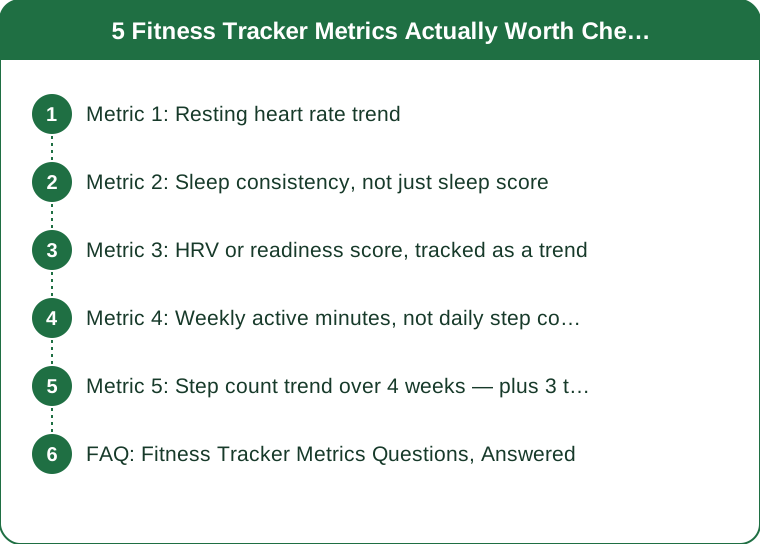
Metric 1: Resting heart rate trend
A single day’s resting heart rate (RHR) bounces around with sleep, hydration, and stress, but the 7-day trend line is a genuinely useful early signal — a sustained upward drift often shows up before you consciously feel run-down, overtrained, or getting sick.
Metric 2: Sleep consistency, not just sleep score
The nightly ‘sleep score’ varies more than it should based on algorithm quirks, but bedtime and wake-time consistency — going to bed and waking within the same 30-60 minute window daily — is one of the most reliable predictors of how good sleep actually feels, and it’s a metric most people never look at directly.
Metric 3: HRV or readiness score, tracked as a trend
Heart rate variability reflects nervous system recovery, and while the daily number is noisy, a week-over-week downward trend is a legitimate signal to schedule an easier training week before burnout or illness hits.

Metric 4: Weekly active minutes, not daily step count
Daily steps swing wildly with an ordinary errand day or a day at a desk, but total weekly active minutes — the metric most public health guidelines actually use (150+ minutes moderate activity) — gives a far more honest picture of whether you’re meeting activity targets.
Metric 5: Step count trend over 4 weeks — plus 3 to mostly ignore
Rather than any single day’s steps, the 4-week moving average shows whether your baseline activity is actually rising or falling, which matters more than any one busy or lazy day.
Three numbers worth mostly ignoring: exact calorie burn (trackers are frequently off by 20-30%), VO2 max estimates (useful as a rough trend, not a precise fitness score), and daily step totals compared to a fixed 10,000 target (an arbitrary marketing number, not a research-backed threshold).
FAQ: Fitness Tracker Metrics Questions, Answered
Should I trust my tracker’s calorie burn for weight loss planning?
Not precisely — use it as a rough relative comparison between workouts, not an exact number to subtract from your daily food intake.
Is a high readiness score a green light to always push hard?
Generally yes as a rough guide, but it should complement how you actually feel that day, not override clear signals like persistent soreness or poor sleep the tracker might not fully capture.
Why does my resting heart rate vary so much day to day?
Alcohol, dehydration, illness onset, and even a late big meal can shift RHR by several beats overnight — which is exactly why the trend line matters more than any single morning’s number.
TL;DR:
- RHR trend, sleep consistency, HRV trend, weekly active minutes, and 4-week step average matter most
- Exact calorie burn, VO2 max scores, and single-day step totals are mostly noise
- Trends over days and weeks beat any single day’s number for almost every metric
- Use readiness scores as a guide alongside how you feel, not a strict rule
Keep Reading
This article is for general informational and styling purposes only. Fit, sizing, and product availability may vary.