Why Your Fitness Tracker's Step Count Is Probably Wrong (and When It Actually Matters)
Quick Answer: Wrist-worn trackers are reasonably accurate for walking on flat ground (usually within 5-10% of true count) but become noticeably less reliable during activities with limited arm movement, like pushing a stroller, cycling, or carrying items — for most everyday tracking purposes the small margin of error doesn’t matter much, but it’s worth knowing when to trust the number less.
Step count is one of the most-used but least-scrutinized fitness metrics, and understanding where it breaks down helps you know when to actually trust it.

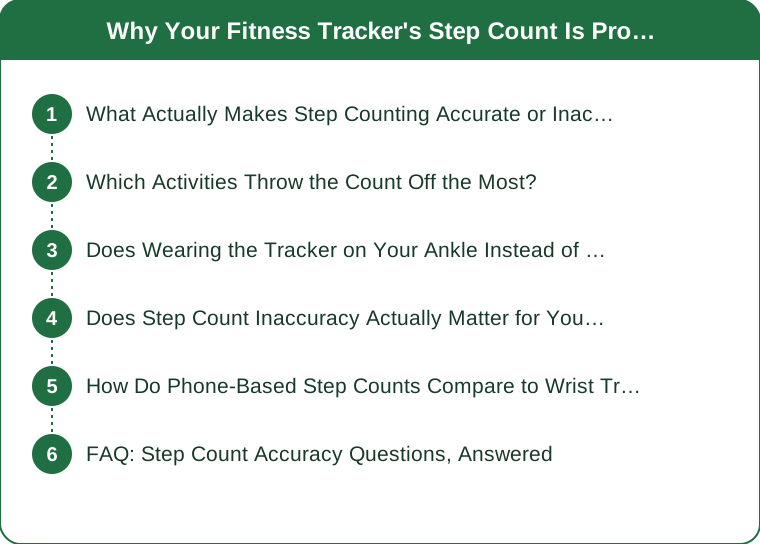
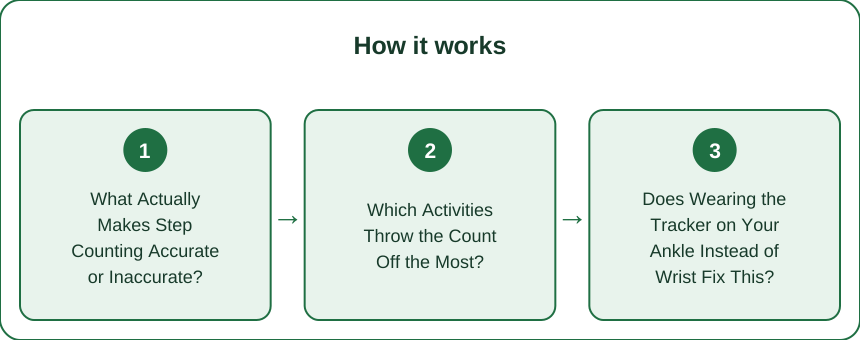
What Actually Makes Step Counting Accurate or Inaccurate?
Most wrist-worn trackers estimate steps using accelerometer data detecting the rhythmic arm swing associated with walking. This works reasonably well for normal walking and running on flat, even ground, where arm swing correlates closely with actual steps taken. Accuracy studies generally show 5-10% margin of error for typical walking in these conditions — good enough for tracking trends over time, even if any single day’s number isn’t perfectly exact.
Which Activities Throw the Count Off the Most?
Pushing a stroller or shopping cart, carrying a baby, cycling, and activities where your arms are relatively still (like using an elliptical while gripping the handles) all significantly undercount steps, sometimes dramatically, because the tracker is relying on arm movement it isn’t getting. Conversely, activities with a lot of arm movement without actual stepping — vigorous dishwashing, some strength exercises, driving over bumpy roads — can occasionally overcount.
Does Wearing the Tracker on Your Ankle Instead of Wrist Fix This?
Some trackers offer this option, and ankle placement does generally improve accuracy for activities like stroller-pushing where wrist movement is limited but leg movement is normal — worth considering if your daily activity regularly includes these undercounted scenarios and step count accuracy matters to your goals.

Does Step Count Inaccuracy Actually Matter for Your Health Goals?
For general activity tracking and trend awareness (are you more or less active this week than last), the margin of error rarely matters — you’re looking at patterns over time, not precise daily totals. It matters more if you’re specifically chasing a hard numeric goal (exactly 10,000 steps) during an undercounted activity, where the tracker might show you’re short when you’ve actually been quite active.
How Do Phone-Based Step Counts Compare to Wrist Trackers?
Phone accelerometers, when the phone is in a pocket, tend to be reasonably accurate for walking too, but obviously miss all activity when the phone isn’t on your body, which happens more often than most people realize (phone left on a desk, in a bag on the floor). Neither method is perfect; the practical takeaway is picking whichever you’ll actually carry or wear consistently, since consistency of tracking matters more than marginal accuracy differences between methods.
FAQ: Step Count Accuracy Questions, Answered
Should I trust my tracker’s calorie estimate from steps, or is that even less accurate?
Calorie estimates from steps are generally less accurate than the step count itself, since they layer additional assumptions about stride length and effort on top of an already-approximate step number — treat calorie estimates as rough, not precise.
Does a more expensive tracker mean more accurate step counting?
Not necessarily in a straightforward way — accuracy depends more on the specific accelerometer algorithm and calibration than price point alone; check independent accuracy reviews rather than assuming cost predicts accuracy.
Is it worth manually logging activities that undercount, like stroller walks?
If hitting a specific step goal matters to you and you regularly do undercounted activities, manually logging or using an activity-specific mode (if your tracker offers one) gives you a more honest total.
TL;DR:
- Wrist trackers are reasonably accurate (within 5-10%) for normal walking on flat ground
- Stroller-pushing, cycling, and limited-arm-movement activities significantly undercount
- Ankle placement can improve accuracy for specific undercounted scenarios
- For trend tracking, small inaccuracies rarely matter — they matter more for hitting exact daily targets
Treat your step count as a useful trend indicator, not a precise measurement, and you’ll get more value from it with less frustration.
Keep Reading
This article is for general informational and styling purposes only. Fit, sizing, and product availability may vary.