5 Things to Know About Fitness Tracker Accuracy in the Water
Quick Answer: Heart rate accuracy drops noticeably in water for most wrist-based trackers because the optical sensors that measure blood flow through skin struggle with water interference and the tighter, different-positioned strap most people wear while swimming, while lap counting and distance tend to be more reliable since they rely on motion sensors rather than optical light.
Water workouts are one of the areas where understanding which specific metrics a tracker handles well (versus which ones to take with real skepticism) matters more than for most other activity types.

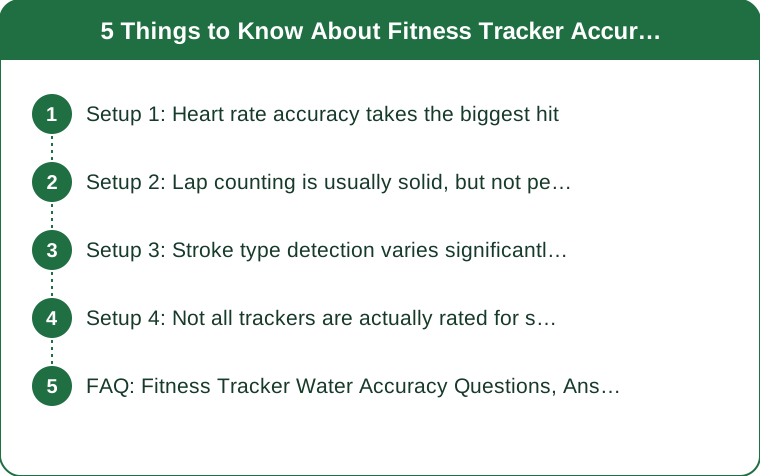
Setup 1: Heart rate accuracy takes the biggest hit
Optical heart rate sensors rely on light reflecting off blood vessels near the skin surface, and water — along with the different wrist strap tension many people use while swimming — interferes with that signal more than almost any other common workout condition, making heart rate zones during swimming meaningfully less trustworthy than during a run or cycle.
Setup 2: Lap counting is usually solid, but not perfect
Most swim-rated trackers count laps reasonably accurately by detecting the distinct motion pattern of a wall push-off and turn, though irregular strokes, open turns, or resting mid-pool can occasionally throw off the count — spot-checking against your own lap count periodically is worth doing until you trust a specific device’s pattern.

Setup 3: Stroke type detection varies significantly by brand
Automatic stroke-type identification (freestyle vs. breaststroke vs. backstroke) works reasonably well for consistent, textbook form but can misclassify mixed or less traditional strokes — this matters less for casual swimmers but is worth checking for anyone tracking stroke-specific training.
Setup 4: Not all trackers are actually rated for swimming
Water resistance ratings vary — a tracker rated for splash resistance or handwashing isn’t necessarily rated for sustained submersion or pool chemical exposure, and checking the specific swim-rated designation (not just general water resistance) avoids both inaccurate data and potential device damage.
FAQ: Fitness Tracker Water Accuracy Questions, Answered
Should I trust calorie burn estimates from swimming on my tracker?
Calorie estimates during swimming tend to be less accurate than for land activities, partly because they often rely on heart rate data that’s already less reliable in water — treating swim calorie estimates as a rough approximation rather than a precise figure is the more realistic approach.
Does a chest strap heart rate monitor solve the water accuracy problem?
Yes, generally — chest strap monitors use electrical signal detection rather than optical light sensing, making them significantly more accurate in water than wrist-based optical sensors, which is why serious swim training often pairs a tracker with a compatible chest strap.
Is GPS distance tracking relevant for pool swimming?
No — GPS doesn’t function underwater or reliably through most pool environments, so pool swim distance relies entirely on lap-counting algorithms rather than GPS, while open water swimming can use GPS since the wrist periodically breaks the surface.
TL;DR:
- Heart rate accuracy drops the most in water due to optical sensor interference
- Lap counting is generally reliable but worth spot-checking against your own count
- Stroke detection varies by brand and works best with consistent, textbook form
- A chest strap monitor solves the heart rate accuracy problem far better than wrist sensors alone
Knowing which specific metrics hold up in water lets you actually use tracker data for swimming without over-trusting the numbers that don’t.
Keep Reading
This article is for general informational and styling purposes only. Fit, sizing, and product availability may vary.