5 Tracker Numbers Worth Checking Weekly (and 3 Worth Ignoring)
Quick Answer: The five metrics with the best signal-to-noise ratio for most people are resting heart rate trend, heart rate variability trend, sleep consistency, total daily steps, and the device’s cardio fitness estimate. All five are useful as trends over weeks, not as daily readings. The three worth ignoring are daily calorie burn, sleep stage breakdowns, and daily readiness or recovery scores - all three are either poorly validated or too noisy to act on day to day.
Check weekly. Daily checking on any of these produces anxiety rather than information.

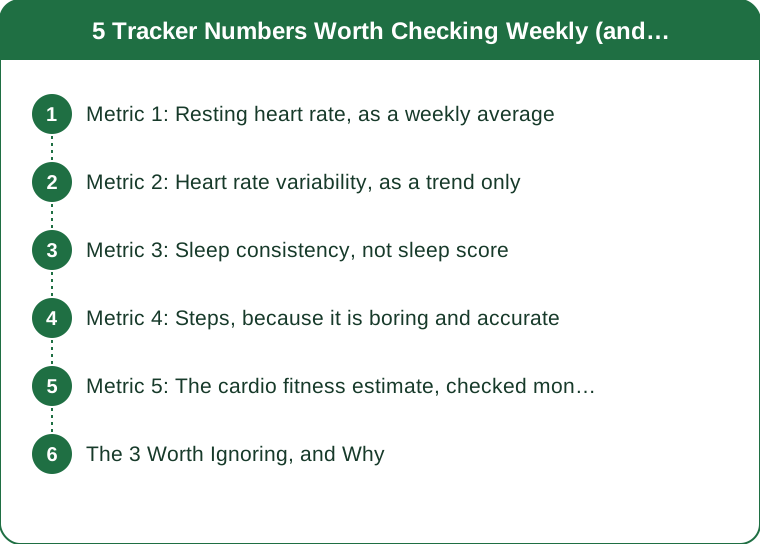
Metric 1: Resting heart rate, as a weekly average
The single most useful number your device produces, and the most consistently underused.
Resting heart rate is measured reliably by essentially every device, has decades of research behind it, and responds meaningfully to fitness, illness, sleep, alcohol, and stress. A well-trained person generally has a lower resting heart rate than an untrained one, and improvements in fitness show up here within weeks.
What to actually do with it: take the weekly average and compare it to previous weeks. A single day’s reading varies by several beats for reasons that mean nothing.
What a change tells you:
- A gradual decline over months: improving cardiovascular fitness. This is the clearest fitness feedback a consumer device gives.
- A sudden rise of 5 or more beats sustained for two or three days: commonly illness, often before you feel symptoms, and sometimes accumulated training fatigue or poor sleep. This is a genuinely useful early warning.
- A rise that persists for weeks with no obvious cause: worth mentioning to a doctor.
The most common mistake is comparing today’s number to yesterday’s. Alcohol alone can raise resting heart rate by several beats overnight, as can a late meal or a warm room.
Metric 2: Heart rate variability, as a trend only
High-value information wrapped in the noisiest presentation on any fitness device.
HRV measures the variation in time between heartbeats, and higher variability generally indicates greater parasympathetic - rest and recovery - activity. It responds to training load, sleep, alcohol, illness, and psychological stress.
The problem is that HRV is enormously variable between individuals and day to day within an individual. Absolute values are close to meaningless for comparison - a healthy person might sit at 30 or at 120 depending on age, genetics, and measurement method. Comparing yours to a friend’s is pointless.
What is useful is your own trend against your own baseline, over at least a two-week window. Most devices now present a personal baseline range for exactly this reason.
How to read it:
- Within your normal range: no information. Do not act on it.
- Consistently below baseline for several days: accumulated stress from some source - training, sleep, illness, life. Worth reducing load somewhere.
- Trending up over months: generally a good sign, often accompanying improved fitness and sleep.
The caution worth stating: HRV is the metric most likely to make people anxious, and anxiety itself lowers HRV. If checking it makes you worry, that is a self-defeating loop and the correct response is to stop checking it daily.
Metric 3: Sleep consistency, not sleep score
The sleep metric with the best evidence is also the simplest, and most devices bury it.
Sleep timing consistency - going to bed and waking at similar times - is associated with better health outcomes in research, and in some analyses tracks outcomes more strongly than total duration does. It is also measured accurately, because a device only needs to know when sleep started and ended, which wrist accelerometry and heart rate do well.
Contrast that with the sleep stage breakdown, which requires distinguishing REM from deep from light sleep. Consumer devices infer this from movement and heart rate patterns, and validation studies consistently find only moderate agreement with polysomnography, the clinical standard. The pretty hypnogram is an estimate built on an estimate.
So the useful weekly check is:
- How much did my bed and wake times vary this week? Under about an hour of variation is good. Several hours suggests a genuine target.
- What was my average duration? Roughly accurate, and worth knowing.
And the thing to ignore is the deep sleep number, which people worry about disproportionately. Deep sleep naturally declines with age and varies substantially night to night, and there is no reliable action you can take to increase a specific stage anyway.
Metric 4: Steps, because it is boring and accurate
The oldest metric on the device and still one of the two or three most useful.
Step counting from wrist accelerometry is well validated and accurate to within a few percent for normal walking. It is one of very few numbers on a tracker that is genuinely measured rather than estimated from a model.
More importantly, the underlying association is robust. Large studies have found meaningful mortality risk reduction associated with increasing daily steps, with benefits accumulating from quite low baselines and the curve flattening somewhere in the 7,000 to 9,000 range for many populations. The 10,000 figure originated as a Japanese pedometer marketing slogan in the 1960s, not from research - but the general direction has held up well.
What to check weekly: the weekly total or daily average, not individual days. Daily step counts are dominated by whether you happened to have a commute or an errand, and chasing a daily number produces a lot of pointless walking at 11pm.
Two things it does not capture, worth remembering: intensity, since 8,000 slow steps and 8,000 brisk ones count identically, and any non-step activity - cycling, swimming, lifting - which registers as almost nothing.
Metric 5: The cardio fitness estimate, checked monthly
An estimated VO2 max is the closest thing a consumer device offers to a fitness score, and it is more useful than most people realise - with one large caveat.
Devices estimate cardiorespiratory fitness from the relationship between your heart rate and your pace during outdoor activity. It requires GPS-based running or walking data to work well, which is why the number is unreliable or absent for people who mostly cycle, swim, or lift.
The absolute value is not very accurate - studies find consumer estimates can differ meaningfully from laboratory measurement. But the direction of change over time is reasonably reliable, and cardiorespiratory fitness is one of the strongest single predictors of long-term health outcomes in the literature.
How to use it: check monthly, not weekly. It moves slowly by design, and short-term fluctuations are mostly artefacts of what activities you happened to record.
- Rising over months: your training is working.
- Flat over months despite consistent training: usually a sign that intensity is missing. This metric responds most to harder efforts, and steady moderate work plateaus it.
- Falling: either reduced training or, if training is unchanged, worth paying attention to.
This is the one number on the list that most directly answers the question people actually want answered, which is whether the training is working.
The 3 Worth Ignoring, and Why
Daily calorie burn. The least accurate significant number on any consumer device. Validation studies have repeatedly found energy expenditure estimates off by wide margins - error rates of 20 to 30 percent or more are common, and they vary by activity type, body composition, and device. Total daily energy expenditure is estimated from a model of your basal rate plus movement, and neither part is measured directly. Using it to plan intake is how people end up eating a few hundred calories a day off target without knowing it.
Sleep stage breakdowns. As above - only moderate agreement with clinical measurement, and no actionable response even if accurate. There is no lever you can pull to produce more deep sleep specifically. Total duration and consistency are the useful parts, and both are measured far more reliably.
Daily readiness or recovery scores. These composite numbers combine HRV, resting heart rate, sleep, and recent activity into a single score. The inputs are reasonable; the weighting is proprietary and unvalidated, and the output changes enough day to day that people routinely override a good session because a number said 62. Worse, there is a documented tendency for a poor score to become self-fulfilling - people who are told they slept badly perform worse regardless of how they actually slept.
The general principle across all three: be suspicious of any number that is modelled rather than measured, and of any number presented daily that only means something weekly. The device is designed to give you something new to look at every morning. That is a product decision, not a physiological one.
TL;DR:
- Resting heart rate weekly average is the best single number - a sustained 5-beat rise often precedes illness by a day or two.
- HRV is useful only as your own trend against your own baseline over two weeks; absolute values and daily readings are noise.
- Track sleep consistency and duration, not the stage breakdown, which has only moderate agreement with clinical measurement.
- Steps are one of the few genuinely measured numbers; check the weekly average, and know the 10,000 target was a marketing slogan.
- Check the cardio fitness estimate monthly - the absolute value is rough but the direction of change is reliable.
- Ignore daily calorie burn, sleep stages, and readiness scores: all modelled, all noisy, and readiness scores can become self-fulfilling.
One rule covers most of it: be suspicious of any number that is modelled rather than measured. This is general information, not medical advice.
Keep Reading
This article is for general informational and styling purposes only. Fit, sizing, and product availability may vary.