5 Tracker Readings That Shift When the Weather Cools
Quick Answer: Five tracker readings move predictably as temperatures drop: heart rate at the same pace falls, resting heart rate drifts down, sleep metrics improve, calorie estimates decrease, and skin temperature readings shift enough to affect recovery scores. None of these mean your fitness changed overnight. They mean the environmental input changed, and comparing September numbers to August numbers without accounting for that produces the wrong conclusion.
Every autumn a large number of people conclude they got dramatically fitter in one week. What actually happened is that it stopped being 88 degrees.

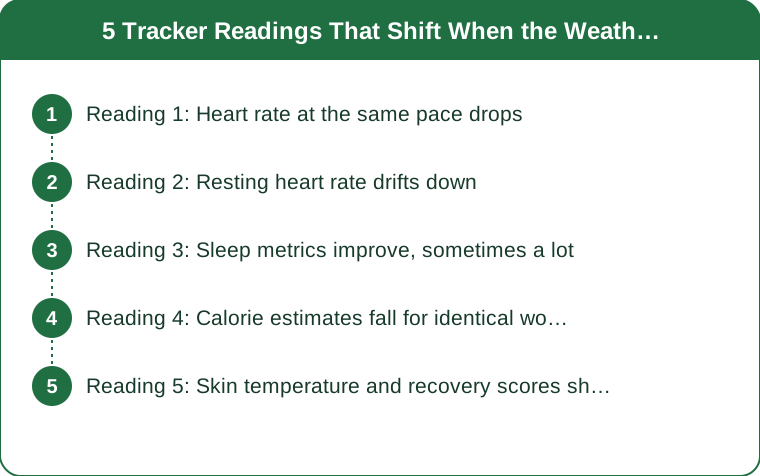
Reading 1: Heart rate at the same pace drops
The most dramatic seasonal shift and the one people notice first.
Why it moves. In heat, your body diverts a substantial amount of blood flow to the skin for cooling. That reduces the volume returning to the heart per beat, so heart rate rises to maintain output. This is called cardiac drift, and in hot humid conditions it can add a meaningful number of beats per minute at an identical pace.
What you see in September. The same easy run at the same pace suddenly sits 8 to 15 beats lower. Your zone 2 pace appears to have improved by a large margin in two weeks.
What it actually means. Some of it is genuine summer training adaptation - heat training does produce real cardiovascular benefits, including plasma volume expansion. But the majority of a sudden two-week improvement is the removal of a heat penalty, not the addition of fitness.
How to use it. Do not reset your training zones based on the first cool week. Wait two to three weeks of stable temperatures, then reassess. Zones set during a transitional week will be wrong in both directions.
Reading 2: Resting heart rate drifts down
A smaller move than the training heart rate change, and it shows up on the daily dashboard where people look most often.
Why it moves. Resting heart rate is sensitive to ambient temperature, hydration status and sleep quality - all three of which improve when the nights cool off. Sleeping in a cooler room reduces the thermoregulatory work your body does overnight.
Typical shift. Two to five beats per minute lower across a few weeks of cooling, for many people.
Why it matters. Resting heart rate is one of the better simple markers of training status and recovery, and a seasonal drift can mask a genuine trend. If you were slowly accumulating fatigue in September, the cooling could hide it for several weeks.
How to use it. Watch the shape of the trend rather than the absolute number, and compare against the same period last year if your tracker holds that much history. A sudden spike against your new autumn baseline is still meaningful - it is the slow drift that needs the seasonal asterisk.

Reading 3: Sleep metrics improve, sometimes a lot
One of the most reliable seasonal changes and one of the least discussed.
Why it moves. Core body temperature needs to fall for sleep to initiate and deepen, and a cooler bedroom makes that easier. Sleep research consistently identifies a cool room as one of the more reliable environmental factors in sleep quality.
What you see. More total sleep, less recorded wake time, and often a notable increase in deep sleep in the first cool weeks of the season.
The complication. Daylight is also shortening, and light exposure is the primary circadian input. Later sunrises can push your natural wake time later while your alarm stays fixed, so some people see better sleep quality and less total sleep at the same time.
How to use it. If deep sleep jumped in September, that is likely genuine and worth protecting - keep the bedroom cool as the heating season starts. If total sleep dropped despite better quality, add morning light exposure rather than an earlier bedtime.
Reading 4: Calorie estimates fall for identical workouts
The reading people find most annoying, because it looks like the workout counted for less.
Why it moves. Most wrist-based calorie estimates are driven largely by heart rate. Heart rate falls in cooler conditions at the same workload, so the estimate falls with it.
Was the summer number right? Not exactly. The elevated heart rate in heat reflects thermoregulatory work, not additional mechanical work, so summer estimates were partly counting cooling effort. Neither number is precise - wrist-based calorie estimates carry substantial error margins in both directions.
What did not change. The actual work you did. Same distance, same pace, same weight moved.
How to use it. Stop using calorie estimates as a training metric. Use duration, distance, pace, power or load instead - all of which are measured rather than modeled. If you track intake against burn, expect the autumn estimate to be lower and do not treat the difference as a change in your training.
Reading 5: Skin temperature and recovery scores shift together
The most confusing item, because the mechanism is invisible and the output is a single score.
Why it moves. Many modern trackers measure skin temperature deviation from your personal baseline, and feed it into a recovery or readiness score. When ambient temperature drops, skin temperature drops, and if the device is still comparing to a summer baseline, it reads a deviation.
What you see. Recovery scores that swing more than usual, or a run of unexplained low-readiness mornings during a transitional week, with nothing else in the data to justify it.
The baseline resets, but not instantly. Most devices recalibrate over one to three weeks. That transitional period is exactly when the scores are least reliable.
How to use it. During the first few weeks of a temperature shift, weight your subjective feel more heavily than the score. If you feel good and the score says otherwise for four consecutive days without a corresponding change in training or sleep, the device is probably still catching up to the season rather than detecting something about you.
TL;DR:
- Heart rate at the same pace drops 8 to 15 beats when heat is removed - do not reset training zones on the first cool week.
- Resting heart rate drifts down two to five beats and can mask a genuine fatigue trend.
- Sleep quality usually improves while total sleep may fall with later sunrises - add morning light, not an earlier bedtime.
- Calorie estimates fall because they are driven by heart rate, not because the workout counted for less.
- Skin temperature baselines take one to three weeks to recalibrate, so recovery scores are least reliable during the transition.
September is the month your tracker tells you the most flattering story of the year. Enjoy it, wait three weeks, and then set your zones.
Keep Reading
This article is for general informational and styling purposes only. Fit, sizing, and product availability may vary.