Running Apps: What's Actually Worth Paying For
Quick Answer: The free tier of every major running app covers GPS, pace, distance, route history, basic training plans, and the social feed — everything a beginner or intermediate runner needs. Only two premium features reliably earn a subscription: adaptive training plans for a specific race goal, and live safety tracking for solo runners.
Every running app runs the same play. Free tier, then a premium screen that heavily implies your 5K is at risk without it.
It isn’t. The free tier isn’t a demo — for most runners, it is the product, subsidized by the roughly 5% of users who upgrade out of hope.
Here’s the honest audit of what’s worth $60–80 a year and what isn’t.

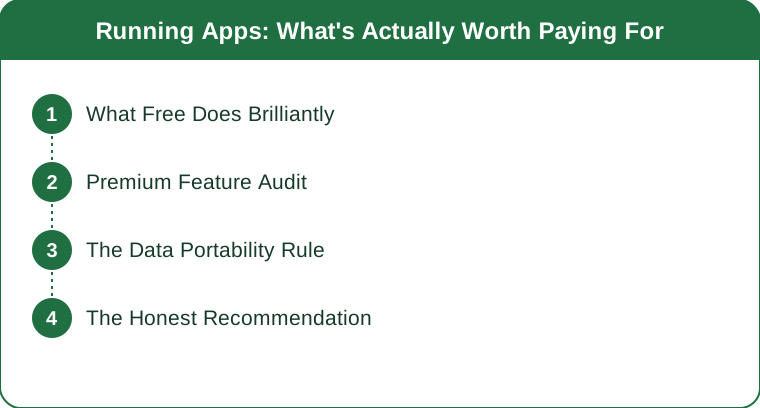
What do free running apps actually give you?
More than the upgrade screen wants you to believe.
Across the major apps, the free tier reliably includes:
- GPS tracking with distance, pace, elevation, and splits
- Route history — every run you’ve logged, mapped
- Basic training plans for 5K, 10K, and often half marathon
- Audio cues for pace and distance
- The social layer — following friends, kudos, clubs
- Basic heart-rate display if you’ve paired a watch or chest strap
That is a complete toolkit for going from your first run to a decent half marathon. The core measurement — how far, how fast, where — is free everywhere and has been for a decade. GPS is a commodity; nobody can charge for it.
If you’re running 3–4 times a week without a specific time goal, you are unlikely to hit a genuine limitation in the free tier. Ever.
Which premium features are actually worth paying for?
Two, in my read, and both solve a real problem rather than manufacturing one.
1. Adaptive training plans. A static plan tells you to run 8 miles Saturday. An adaptive plan notices you missed Wednesday, were slower than expected Thursday, and adjusts Saturday accordingly. That’s genuinely useful when you have a dated race goal, because the main way training plans fail is that life happens and the plan doesn’t care. Worth it for a 12–16 week race build. Cancel afterward.
2. Live safety tracking. Real-time location sharing with a chosen contact, plus incident detection on some apps. For anyone running alone, at night, or on unfamiliar routes, this is the one feature where the value isn’t about performance at all. Worth it on peace-of-mind grounds alone — and some apps now include a basic version free, so check before paying.
What’s decorative:
- Badge and challenge systems. Fun. Not $80 of fun.
- Composite “fitness scores.” A single number derived from data you can already see, presented with more confidence than the underlying estimate deserves.
- Celebrity-narrated guided runs. Genuinely delightful. Also completely optional, and there’s a lot of free audio out there.
- Advanced analytics like ground contact time and vertical oscillation. Interesting if you’re chasing a marathon PR and already have coaching. Noise for everyone else.

Why does data portability matter more than features?
Because a few years of runs is a diary, and you should own it.
Before your habit deepens, check one thing: can you bulk-export your history in a standard format (GPX or TCX)? Most major apps allow it. Some make it deliberately awkward, and a few gate it behind the subscription — which is a meaningful signal about how they view the relationship.
Why it matters: apps get acquired, change pricing, or shut down. Runners who switch platforms after five years and lose their entire history are a very common story, and it’s entirely avoidable.
Do this now, not later: find the export setting, run it once, and save the file somewhere you control. It takes about four minutes. Then set a reminder to repeat it annually.
A close second: check whether the app syncs to a neutral third party. Having your runs land in two places automatically is the cheapest insurance available.
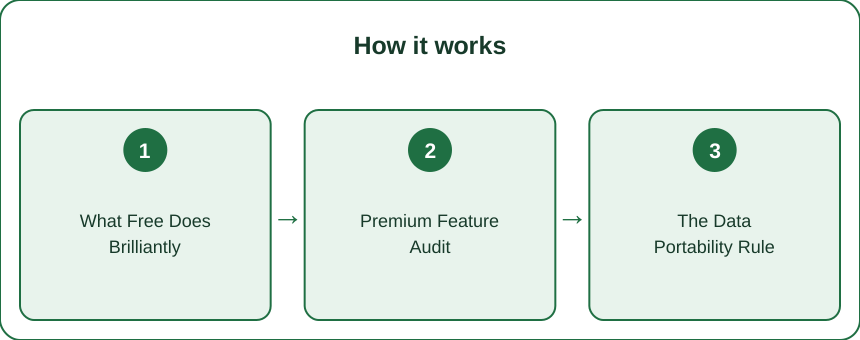
So what should I actually do?
Run free for six months. Seriously — six months of consistent running will teach you more about what you need than any comparison chart.
Then subscribe only when you can finish this sentence: “I’m paying for this because I need ___.”
- Training for a specific race on a specific date → adaptive plan, for the build only
- Running alone at night or on remote routes → safety tracking
- Neither of the above → keep your $80
Subscribe seasonally, not perpetually. Most people need the adaptive plan for 12–16 weeks a year and nothing the rest of the time. Cancel and resubscribe; nearly every app lets you.
And be honest about the psychology. Most fitness subscriptions get bought in January to become a certain kind of runner, and the subscription has never once made anyone run. Fund the feature, not the fear.
Myth vs Fact
Myth: Premium gives you more accurate GPS. Fact: GPS accuracy comes from your phone or watch hardware and satellite conditions. It’s identical on both tiers.
Myth: You need a paid plan to train for a marathon. Fact: Free structured plans for every common distance have been publicly available for decades. Paid plans add adaptation, not the training itself.
Myth: The subscription includes coaching. Fact: It includes an algorithm. Real coaching costs considerably more and is a different product entirely.
FAQ
Is a paid running app worth it for beginners?
No. Beginners benefit almost entirely from consistency, and the free tier tracks consistency perfectly. Spend the $80 on shoes that fit properly — that’s a purchase that measurably changes your running, and a subscription isn’t.
What’s the difference between free and premium training plans?
Free plans are static: a fixed schedule you follow or fall off. Premium plans are adaptive: they adjust future workouts based on what you actually completed and how it went. For a flexible-goal runner the difference is minor; for a race build with a hard date, it’s the main thing worth paying for.
Do I need a running watch, or is my phone enough?
Your phone is genuinely fine for road running. A watch is worth it when you want continuous heart rate, don’t want to carry a phone, or run trails where you’ll want the battery. Comfortable gear matters more than either — most runners find high waist leggings with a real pocket eliminate the phone-carrying problem entirely, which is often the actual reason people buy a watch.
Can I switch running apps without losing my data?
Usually yes, via GPX or TCX export and import. Do the export before you need it — some apps’ export tools are slow or partially broken, and finding that out during a migration is the wrong time.
TL;DR:
- Free covers GPS, pace, routes, basic plans, and social — that’s a complete toolkit
- Worth paying for: adaptive plans (during a race build only) and live safety tracking
- Not worth it: badges, composite fitness scores, celebrity runs, advanced gait analytics
- Export your history now — GPX or TCX, saved somewhere you control
- Run free for six months, then subscribe only to a need you can name
- Subscribe seasonally, not perpetually
The app was never running the miles. Fund the feature, not the fear.
Keep Reading
This article is for general informational and styling purposes only. Fit, sizing, and product availability may vary.