Why Your Tracker's Calorie Burn Number Is Wrong (and What to Use Instead)
Quick Answer: Validation studies consistently find wrist trackers misjudge calorie burn by 20 to 50 percent or more depending on the activity - among the worst error rates of anything they measure - because burn is estimated from heart rate and arm movement fed through population formulas that cannot see your individual physiology. Steps, workout duration, consistency streaks, and week-over-week trends are far more trustworthy. The practical move is not tossing the tracker; it is demoting the calorie number from fact to rough index and never, ever eating it back.
The watch says 427 calories with a decimal point of confidence, and the smoothie shop across from the gym is happy to sell you 450 of them back. One of these numbers is precise. Neither is accurate. Understanding the gap is the difference between a tracker that helps and one that quietly runs your nutrition in reverse.

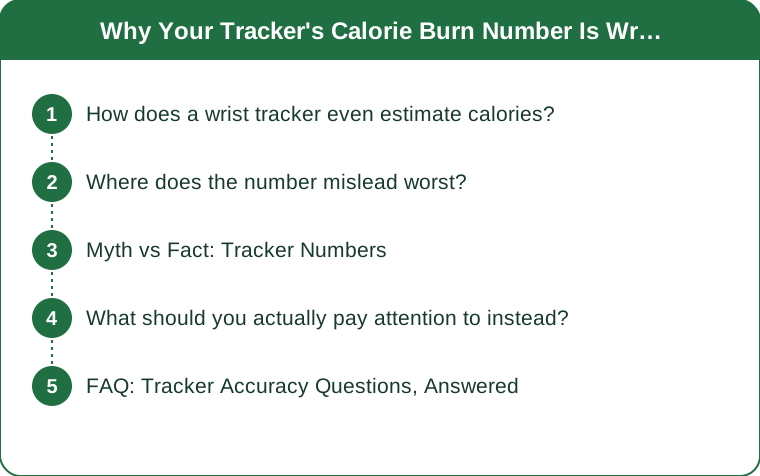
How does a wrist tracker even estimate calories?
Through a chain of guesses, each one reasonable, none of them you.
The inputs are motion and heart rate. An accelerometer reads arm movement; an optical sensor reads pulse at the wrist by shining light into your skin. From these, algorithms infer what activity you are doing and how hard, then convert that into energy via equations built on lab averages - datasets of other people wearing gas-analysis masks that measure true burn.
Every link adds error. Optical heart rate lags and stumbles during rapid changes, wrist tattoos and cool skin and loose bands degrade it, and arm-reading misfires whenever arms and effort decouple - gripping a barbell, pushing a stroller, cycling with still hands, carrying groceries. The activity-recognition step guesses wrong routinely, and the final equations assume a population-average body: your muscle mass, fitness level, hormones, and metabolic efficiency are invisible to them. Two people with identical stats on paper can differ meaningfully in true burn for the same session; the formula hands them the same number.
The validation numbers are humbling. Independent studies comparing consumer wearables against lab metabolic measurement keep finding the same pattern: heart rate tracking is decent, step counting is respectable, and energy expenditure is the weak event - errors commonly in the 20-to-50-percent range, sometimes worse, varying by device, activity, and person. Crucially, the error is not consistent in direction: the same watch may overcount your spin class and undercount your strength session, so you cannot even apply a personal correction factor.
Precision is the costume. Displaying 427 rather than roughly 350 to 500 is a design choice, not a measurement claim. The decimal-point confidence is the interface talking, not the sensor.
Where does the number mislead worst?
Ranked by damage, because some errors are trivia and one is a diet-wrecker.
1. Eating back exercise calories. The classic loop: the watch reports 427, dinner grows by 427, and since the true burn may have been 250, the earned calories quietly erase the deficit - one of the most common reasons diligent trackers see no scale movement. Compensation research shows people reliably overestimate workout burn and underestimate intake even without a gadget; a confident wrong number supercharges the bias. If one habit changes after this article, make it this: the calorie readout never becomes food math.
2. Strength training gets robbed - and misread. Lifting looks like nothing to a wrist: low steps, spiky-but-modest heart rate, still forearms during gripping. The session reads as a light workout while the meaningful adaptations - muscle, bone, strength - are precisely the things calorie counts cannot represent anyway. Lifters who judge sessions by the burn number systematically undervalue their most valuable training.
3. Device-hopping breaks your history. Each brand’s algorithm errs differently, so switching watches can jump your apparent daily burn hundreds of calories with zero change in you. Any long-term comparison spanning two devices is comparing formulas, not fitness.
4. The all-day number inherits the errors and adds new ones. Total daily energy expenditure blends a resting-rate formula with the flawed activity estimates - useful as a very rough order of magnitude, wobbly as anything more. Treating it as a calibration-grade target for daily eating imports every error at once.
5. Pocket-versus-wrist trivia, worth knowing: a phone in a leggings side pocket counts steps from hip motion and often disagrees with the wrist by thousands on stroller days, shopping-cart days, and desk-fidget days. Neither is lying; they are watching different limbs. Pick one step source and stay loyal to it for trend purposes.

Myth vs Fact: Tracker Numbers
Myth: Expensive flagships solve the calorie problem. Fact: Premium devices buy better sensors and often better step and heart data, but validation studies find no consumer wearable at any price achieving consistently accurate energy expenditure. The physics of estimating metabolism from a wrist has a ceiling money does not move.
Myth: A chest strap fixes the calorie number. Fact: A strap fixes the heart-rate input - genuinely, especially for intervals - but the calorie figure still comes from population equations downstream. Better data into the same guess produces a somewhat better guess. Worth it for training by heart rate zones; not a calorie truth machine.
Myth: Closing the ring means the deficit happened. Fact: Rings and goals gamify the estimate, and the estimate inherits every error above. Closing a move ring is a fine consistency prompt and a meaningless accounting entry. Celebrate the streak, ignore the arithmetic.
Myth: Since the number is wrong, tracking is pointless. Fact: The same wrong-in-absolute-terms number can be useful as a relative index on one device, one person, one activity type: if Tuesday’s usual run reads 300-ish for months and starts reading 260 at the same pace, something real changed - fitness improved, or effort dropped. Wrong absolutes can still draw honest trend lines, provided the device and context stay constant.
Myth: Trackers measure health. Fact: They measure behavior - movement, frequency, duration, sleep timing - and behavior is the part you control anyway. The devices are excellent mirrors and mediocre accountants; use them for what they see, not what they compute.
What should you actually pay attention to instead?
The trustworthy dashboard, in order of reliability.
1. Did-it-happen data: sessions, duration, streaks. The tracker is nearly flawless at recording that you worked out, for how long, and how often. Consistency is the single strongest predictor of every fitness outcome, and this is the metric set where the device is essentially incapable of lying. Make weekly session count your headline number.
2. Steps - as a personal trend, not a contest. Step counts are decently accurate and, held to one device, comparable across weeks. Whether your true number is 8,000 or the watch’s 8,600 matters far less than whether your average is rising, falling, or holding through late-summer heat. Movement volume trends predict a lot; step-count precision predicts nothing.
3. Heart rate - live, and over months. Mid-workout heart rate (strap-grade if you train seriously) supports honest effort management - easy days actually easy, hard days actually hard. And long-run resting heart rate is one of the quiet gems in the whole device: a gently falling resting rate across a consistent training block is real, visible cardiovascular adaptation, measured while you sleep.
4. Effort you rate yourself. A zero-to-ten how hard was that after each session calibrates surprisingly well against lab measures and needs no battery. Paired with duration, it beats the calorie readout at its own job: harder-plus-longer weeks are bigger weeks, no wattage math required.
5. Results that are not on the wrist. Weights lifted, distances at a given effort, how stairs feel, sleep quality, waistbands, photos, energy at 3pm. The tracker is one witness, not the court.
And the settings change that enforces all of it: most apps let you rearrange the dashboard - demote calories off the front screen, promote sessions, steps, and resting heart rate. Out of sight genuinely helps; the number cannot run your dinner from a submenu.
Keep the tracker. Fire it from accounting, promote it to witness - the streaks, the steps, the slowly falling resting heart rate. Everything it sees is useful; the one thing it computes is the one thing to ignore.
FAQ: Tracker Accuracy Questions, Answered
How accurate are fitness tracker calorie counts?
Poorly, per repeated validation studies: errors of 20 to 50 percent or more are routine, varying by device, activity, and individual - and the direction of error is inconsistent, so you cannot simply correct for it. Steps and heart rate fare much better; energy expenditure is consistently the weakest measurement consumer wearables make.
Why does my tracker undercount strength training?
Wrist devices infer effort from arm motion and heart rate. Lifting produces still, gripping forearms, modest step counts, and spiky heart data that algorithms read as light activity - so sessions register far below their real cost, and the adaptations that matter most from lifting never appear in a calorie figure anyway. Log strength by sessions, sets, and loads instead.
Should I eat back the calories my watch says I burned?
No - this is the single most damaging use of the number. The figure is routinely inflated, intake estimates are routinely low, and eating back a wrong number erases real deficits. Set nutrition by a consistent plan, judge by multi-week results, and let the workout readout stay decorative.
What tracker metrics are actually worth watching?
Session count and duration (near-perfect), step trends on one consistent device, live heart rate for effort control, and resting heart rate over months - a gently declining resting rate is genuine fitness showing up. Add your own effort ratings and real-world results, and you have a dashboard that deserves the trust the calorie number borrowed.
TL;DR:
- Calorie burn is the least accurate thing a wrist tracker reports - 20 to 50 percent errors are normal and inconsistent in direction.
- The estimate chain - optical pulse, arm motion, population formulas - cannot see your physiology, and strength training fools it completely.
- Never eat back exercise calories; that loop erases real deficits with fake arithmetic.
- Trust instead: session streaks, duration, step trends on one device, and resting heart rate over months.
- Rearrange the app dashboard - demote calories, promote consistency - and the device becomes honest.
The watch is a superb witness and a terrible accountant. Let it testify to what you did, and keep it away from the books.
Keep Reading
This article is for general informational and styling purposes only. Fit, sizing, and product availability may vary.